AI and Astrology: Can Intelligence Without Consciousness Predict Your Destiny?
- Pt. Punarvasu and Team by Indastro
- May 07, 2026
- Like
- Comments (0)
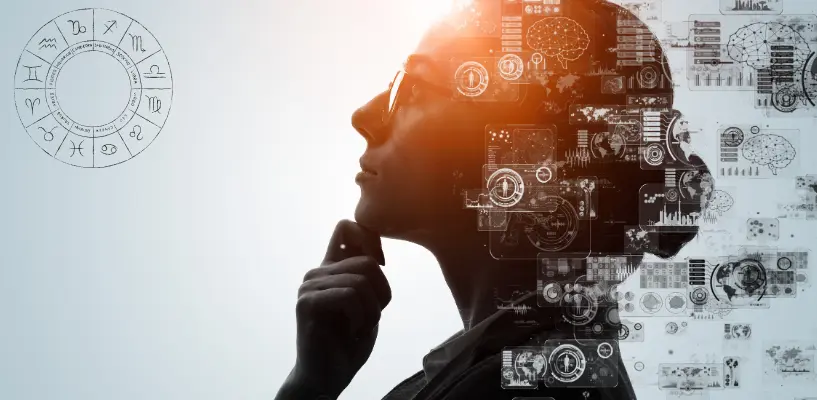
Can I ask you a question?
If astrology is the science of understanding human life, human karmic patterns, human emotions, and human timing… then can something that is not human, ever truly understand it?
Or are we slowly moving toward a world where speed is being mistaken for accuracy, and convenience is being mistaken for true wisdom? In the world of instant noodles, instant delivery and instant relationships, have we grown so desperate that we are ready to accept just about anything as long as it is quick and serves our impatience.
Because that is exactly what is happening with AI in astrology.
And before I go any further, let me be very clear — this is not an argument against AI. This is my point of view against misunderstanding what astrology really is.
Astrology Was Never Just Prediction
Over the past few decades, somewhere along the way, astrology has been reduced to just one thing – “predictions”. Now it’s all about…
“What will happen?”
“When will it happen?”
“Will it be good or bad?”
But if you look at the roots of astrology, especially in Vedic tradition, it was never just about prediction. It was about understanding the give and take between cosmic forces and human consciousness.
There is something else here that people don’t usually talk about.
Astrology is not just about predicting what will happen outside. It is also about preparing what is happening inside you. I have seen this again and again — two people go through the same planetary period, and yet one feels completely shattered while the other somehow grows through it.
So, the question is not just what will happen… but how will you experience it.
And this is where a human astrologer quietly becomes important.
Because they are not just telling you dates or events. They are, in a way, helping you process what is coming — your fear, your expectations, your confusion.
AI can tell you timing.
But it cannot sit with you in that moment and understand what that timing will feel like in your life.
Astrology has always stood on three pillars.
The first is the astronomical part that is the mathematics or calculations in astrology.
The second is interpretation — the ability to interlink planetary influences and understand which force will dominate.
And the third - which is rarely spoken about but absolutely essential is the intuition and emotional intelligence which helps to present the facts to the seeker in accordance with their mental state.
Without all three, astrology becomes incomplete.
This forecast is based on Moon Sign. If you are not aware of your Moon Sign, find out instantly for free by filling the data below:
The First Pillar: Mathematics — Where AI Excels
Let us start with the easiest part.
Calculating planetary positions, degrees, aspects, divisional charts - this is pure mathematics. And this is where AI can be extremely powerful.
In earlier times, astrologers would spend hours, and sometimes even days, calculating charts manually. Today, software does the same thing in seconds. AI can take this even further — faster calculations, pattern detection, large-scale data comparison are all doable with lightning speed because of AI.
There is no debate here. AI can outperform humans in this computation.
But let us be honest — calculation was never the hardest part of astrology. It was only the foundation for something much more complex.
The Second Pillar: Interpretation — Where Things Get Complicated
Now we come to the real challenge.
Astrology is not just about reading one planetary placement. It is about reading contradictions.
A chart may show:
- Strong career potential
- But weak mental stability
- Supportive dasha
- But challenging transits
- A powerful yog
- But an afflicted Moon
Now the question is not what is present.
The question is:
Which force will dominate?
And this is where astrology becomes an art of judgment. You are not just reading planets. You are weighing them against each other trying to judge their strengths and weaknesses through signs, nakshatras, aspects, dashas, degrees, yogas, doshas and much more.
You are asking:
- Which planet has more strength?
- Which house is activated right now?
- Which dasha is running?
- Which result will manifest practically, and which will remain theoretical?
Because here is a truth that many people don’t realize:
Not everything promised in a chart manifests. Some things remain potential. Some possibilities get cancelled. Some things get delayed. Your birth chart does not directly show what the results will be, sometimes even a debilitated planet can also be a hero disguised as a villain and vice versa.
This is where permutation and combination come into play.
AI, to some extent, can be trained here.
It can analyze patterns. It can compare charts. It can learn probabilities.
But astrology is not probability alone. It is prioritization of forces in real time, and that is far more complex than it actually sounds.

Indepth Horoscope Reading
Traditionally a Vedic Astrology reading was created over multiple sittings with an astrologer of experience and repute who would cover all the 12 houses and 9 planets and interprets the chart the way he/she sees, after creating a Vedic birth chart using your accurate date, time & place of birth. more
The Third Pillar: Intuition — The Missing Dimension
Now we come to the most uncomfortable yet crucial part. The part that people either ignore… or cannot explain.
Intuition.
There is a reason why two astrologers can look at the same chart and give slightly different predictions — and yet, both can be correct in different ways.
Because astrology is not only about what is written in the chart. It is also about what is intuitively felt in the moment of interpretation.
An experienced astrologer does not just “read” a chart.
They sense:
- The emotional state of the person
- The psychological readiness for certain events
- The subtle timing of manifestation
- The difference between possibility and probability
This does not need calculation, this is awareness, and this requires empathy.
In the Bhagavad Gita, there is a powerful line:
(Yogah Karmasu Kaushalam)
Yoga is excellence in action.
Astrology, when practiced correctly, becomes a form of this excellence.
Not mechanical, Not repetitive, But purely conscious.
And this is where AI, at least today, reaches its limitation. Because AI can process information. But it cannot experience existence.
How AI Actually Gives Astrology Predictions
Let us deeply understand this in technical terms.
When AI generates astrology predictions, it usually works through:
- Pre-fed astrological rules
- Large datasets of interpretations
- Pattern recognition models
- Language generation systems
It identifies placements, matches them with known meanings and combines them into readable output.
In advanced systems, it may also:
- Compare thousands of charts
- Identify common outcomes
- Generate probability-based insights
This sounds impressive. And it actually is.
But here is the problem, AI does not know which result matters more to you as It does not know:
- Your emotional threshold
- Your karmic readiness
- Your internal resistance
- Your life context beyond data
It gives structured output, but astrology is not just about structured output. It is contextual truth!
What People Are Experiencing with AI-Based Astrology
Let us talk about real people’s feedback.
Most people who use AI-based astrology say two things:
- “It is very fast and convenient.”
- “It sounds accurate… but something feels missing.”
That “something” is important. Because accuracy in astrology is not just about correctness of statements. It is about relevance.
Interestingly, this is not just an isolated observation. Research by PwC has shown that while users appreciate AI for its speed and accessibility, trust drops significantly when decisions become deeply personal or emotionally significant.
And astrology, if understood correctly, is not casual information — it is deeply personal guidance. So even if the output is technically correct, a personal touch, and emotional counselling is still missing…
You can say ten correct things… and still miss the one thing that actually matters. And that is where people feel the gap.
AI feels informative.
But not always insightful.
Because true insight is not just data — it is discernment.

Detailed Life Reading
The Detailed Life Reading is prepared using Vedic predictive means and for this your birth chart is analysed with a deep analysis of the dasa system and all planetary transits during the relevant period. more
Human Astrology — Its Strength and Its Flaws
Having said that, now let us not idealize human astrologers blindly.
Humans do make mistakes. Sometimes personal opinion and Bias enters interpretation. Not every astrologer is the same, their experience and level of dedication varies.
The biggest drawback here is that emotions can interfere true judgement.
Ego can also distort the predictive capabilities.
Not every astrologer is accurate! Not every prediction is correct! But when a skilled astrologer reads a chart, something different happens.
There is interaction.
There is questioning.
There is adaptation.
And most importantly, there is assurance!
The astrologer adjusts their predictions based on:
- Your responses
- Your current life situation
- And your emotional state
And this is not just a philosophical claim — even modern research supports this distinction. Insights from Harvard Business Review suggest that in areas requiring contextual judgment, empathy, and nuanced interpretation, human decision-making continues to outperform fully automated systems.
This is exactly how astrology is supposed to operate. It is not just about reading placements. It is about reading the person who is seeking advice and hope for a better tomorrow.
And that dynamic process cannot be fully replicated mechanically.
Because it is not just analysis, It is human interaction and connection!
Astrology in Ancient Times — Why It Was Never Mechanical
If you look at ancient texts, astrology was not treated as a casual tool. It was a Vidya — a disciplined science mandatory for qualified individuals.
In the Ramayana, before major events, planetary positions were observed carefully. The birth of Lord Rama itself is described with precise astrological combinations. Moreover, for smaller decisions like what time to leave for war, astrology and specifically mahurata rules were applied to calculate favourable timings in order to increase the chances for success. Just as Lakshmana mentions about the favourable position of the pole star in order to leave for Lanka to declare war against Ravana.
Similarly, in traditional gurukul systems, astrology was a mandatory subject for higher knowledge. It was not separate from life — it was integrated into every step of decision-making.
Because people understood something we are forgetting today: Astrology is not about predicting the future, It is about aligning with it.
And alignment requires awareness — not just information.
If Only AI Does Astrology
Let us imagine a world where only AI gives astrology predictions.
It will be, Instant, Cheap, Accessible to everyone and Consistent.
But it will lack:
- Emotional depth
- Contextual judgment
- Spiritual sensitivity
- Human accountability
It will tell you what is likely, but not what is meaningful. It will not give advice, but just possibilities. And if AI based astrology continues over time, it may become:
Accurate in data… but shallow in wisdom.
The true soul and meaningfulness of this ancient wisdom will lose its importance in the eyes of our future generations to come.
Composite Astrology Report
Composite Astrology is by far the most exhaustive personal life reading that you could request for. It is one of the bestsellers on the site. It can be requested for a complete astrological analysis of your birth chart. It covers predictions of your life over the next 20 years. more
If Only Humans Do Astrology
Now let’s imagine the opposite.
If only humans practice astrology like the ancient times,
You will get Depth, Personalization, Intuition, Emotional understanding
But you also get:
- Inconsistency
- Limited scalability
- Time constraints
- Human error
So neither extreme is perfect specially considering the fact that modern humans unlike ancient scholars lack patience and spiritual depth which are two essential requirements for a good astrologer.
The Real Future — When AI Assists, Not Replaces
This is where things become interesting, because the real power lies in combination.
Now Imagine this:
AI calculates flawlessly.
AI identifies patterns instantly.
AI presents all possible outcomes.
And then…
A human astrologer steps in.
They observe the AI given outcomes, they filter the possible results, they prioritize the aspects, yogas, doshas and other important factors, they interpret, and finally they advise.
They decide:
- What matters
- What will manifest
- What must be predicted
And this is where magic happens.
Because now,
Speed meets wisdom.
Data meets consciousness.
Structure meets intuition.
This is not replacement of ancient Vedic knowledge, this is enhancement and simplification of the process to achieve high quality favourable outcomes because AI will help humans minimise their limitations as an astrologer and achieve greater precision.
Final Thought — Intelligence vs Consciousness
Let me end by saying something very simple.
AI is intelligent, but astrology requires human consciousness. And intelligence without consciousness can inform you… But it cannot guide you.
Kaal/ Time, does not just unfold mathematically. It unfolds experientially. And unless something can experience existence, it cannot fully interpret it.
So the question is not:
“Can AI replace astrologers?”
The real question is:
“Can astrology ever be complete without the human element?”
And the answer, at least for now, is a bug “NO”.
But together?
AI and human intelligence… That is not the future of astrology. That is the evolution of it!
You May also Read:
2026 Horoscope | History of Astrology
Knowledge Series by Indastro