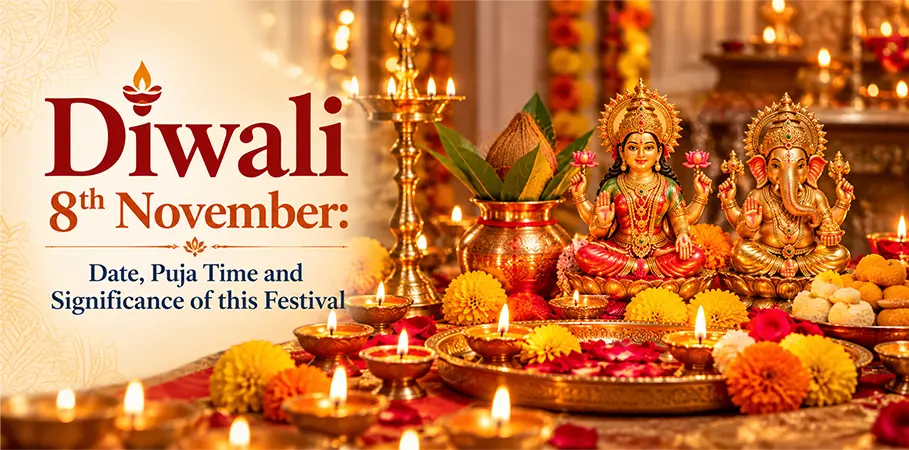
Diwali 8th November: Date, Puja Time and Significance of this Festival
Diwali is celebrated twenty days after Vijayadashami (tenth day of Dussehra). The festivities start with Dhanteras, a by linked with welcoming prosperity and happiness into homes. People clean and declutter their homes, discard unwanted things, repaint their walls, refresh their home décor, and prepare and share sweets and savory snacks with friends, colleagues, relatives, and loved ones.
The second day of Diwali is Naraka Chaturdashi. According to Hindu mythology, during the Dwapara Yug (an age in Hindu tradition), Lord Krishna defeated the demon Narakasura and freed 16,000 girls held captive by him. This day symbolizes the triumph of good over evil. In parts of Southern India, it is observed as a day associated with the darkest night.
The third day is celebrated as Lakshmi Puja and is also associated with the birth of Goddess Lakshmi, who emerged during the Samudra Manthan, the churning of the cosmic ocean of milk by Devas (gods) and Asuras (demons). The fourth day is celebrated as Govardhan Puja and Balipratipada. The fifth day is observed as Bhai Dooj, which celebrates to the bond between sisters and brothers. Some Hindu and Sikh artisans communities also observe Vishwakarma Puja, during which they worship their tools and offer prayers to Lord Vishwakarma, the divine architect.
Claim your unique 30 page FREE Horoscope by filling the form below. We follow Vedic Astrology principles & methods for highly accurate reading.
Dates and Puja Timings, 2026
Dhanteras
‘Dhanteras’ is derived from ‘dhan’ (meaning wealth) and ‘teras’ (meaning thirteen). It marks the thirteenth day of the dark fortnight of Kartik, a month in the Hindu calendar, and the beginning of Diwali. People clean their homes and light ‘diyas’ (traditional earthen lamps) near the idols of Goddess Lakshmi and Lord Ganesha throughout the five-day festivals.
The entrances of homes are decorated with garlands, rangoli (traditional decorative patterns created on the floor) and flowers. Shopping for utensils, jewellery and other items is a common tradition on this day. Dhanteras is also associated with Lord Dhanvantari, the divine healer I Ayurveda, who is believed to have emerged from the churning of the cosmic ocean alongside Goddess Lakshmi and other divine beings.
People also perform Dhanvantri Yagna (a sacred fire ritual) on this day, while some observe Yama Deepam by lighting a traditional lamp. This lamp is made of wheat flour, filled with sesame oil, and placed south in the southern direction at the back of the home. According to Hindu tradition, this ritual is believed to please Yama, the god of death, and help protect against untimely death.
Naraka Chaturdashi, Choti Diwali
Naraka Chaturdashi is also observed as Kali Chaudas, Choti Diwali, Hanuman Puja, Roopa Chaudas, Yama Deepam. ‘Naraka’ means hell, and this day is observed on the 14th lunar to help liberate suffering souls from Naraka (hell) and attain spiritual awareness. It is also a time to pray for liberation from the cycle of death.
Naraka Chaturdashi is an important festival celebrated in parts of northern India. Women traditionally take a ritual bath and enjoy beautifying themselves as part of the celebrations. People also mark the occasion by purchasing festive foods, savory snacks, and gifts. In some parts of Gujarat, the day is also celebrated as Hanuman Puja.
The festival coincides with Kali Chaudas. according to traditional beliefs, spirits roam during this night, and Lord Hanuman protects devotees from negativity. The day also honors Hanuman’s devotion and dedication to Lord Rama. In Tamil Nadu, Maharashtra and Karnataka, the occasion is observed as part of Diwali celebrations. Traditionally, people take a sesame oil bath early in the morning and celebrate with a festive meal fireworks.
Diwali, Lakshmi Puja
Diwali, celebrated during the dark fortnight of the lunar month, is one of the most important festivals in India and is observed by Hindus and Jains across many parts of the country. It symbolizes the victory of light over darkness and is also associated with welcoming prosperity and abundance.
The festival is widely associated with Goddess Lakshmi (the Goddess of Prosperity), Lord Ganesha (the remover of obstacles), and Lord Rama. Diwali celebrates Lord Rama’s return to his kingdom in Ayodhya with his wife, Sita and brother, Lakshmana after defeating the demon, Ravana in Lanka and serving 14 years of exile.
Diwali is known as the festival of lights, which illuminates homes and public spaces across India with decorative lights, diyas (traditional earthen lamps), candles, lanterns, fireworks. The celebrations also incoudes festive meals and social meet-ups. Many towns organize community parades, fairs featuring music and entertainment, food stalls, and other cultural activities.
On this day, Lakshmi Puja is performed. People clean and declutter their homes and decorate them for the celebrations. Business owners may exchange gifts or provide special bonuses to their employees. Many shops remain closed or close early, so employees can spend time with their families.
People wear new outfits, buy jewelry, and offer prayers to Goddess Lakshmi, Lord Kuber, Lord Ganesha, Lord Rama, Goddess Sita, and Lakshmana. After the puja (prayer ritual), families gather to share a festive meal and sweets.
Diwali night is dedicated to Goddess Lakshmi. People welcome her into their clean homes, believing that this invites prosperity and happiness for the coming year. It’s a time for celebration and for sharing joy, warmth and good wishes with friends and loved ones.
Annakoot, Govardhan Puja
The day after Diwali marks the first day of the bright fortnight (the waxing phase of the Moon in te lunisolar calendar). Annakoot, meaning a “heap of grain” or “mountain of grain” is celebrated on this day. Communities prepare 56 varieties of food, known as Chappan Bhog, which are offered at Krishna temples. Devotees gather at these temples for the God’s darshan (sacred viewing of the deity). Annakoot is also observed under names such as Balipratipada, Govardhan Puja, Padwa, Bali Padyami, Kartik Shukla Pratipada.
Balipratipada celebrates the annual return of Asura king, Mahabali to earth. According to Hindu scriptures, Mahabali sought and was granted this boon by Lord Vishnu. In some parts of northern, western and central India, this day is celebrated as Govardhan Puja. It indicates the act of Lord Krishna of protecting cowherds and farming communities from the heavy rains and floods caused by Indra’s anger.
Lord Krishna lifted Govardhan Hill to shelter the villagers and their cattle. Ths act is commemorated by creating miniatures symbols of Govardhan Hill from cow dung.
Bhai Dooj
This festival comes to an end with Bhai Dooj, which celebrates the special bond between brothers and sisters. On this day, brothers visit their sister and their families. The festival is symbolized by the story of Yama’s sister, Yamuna, welcoming Yama with a ‘Tilak’ (an auspicious mark applied on the forehead). Another interpretation links the occasion to Lord Krishna’s visit to his sister Subhadra after defeating the demon Narakasura.

Indu Lagna
Your Indu Lagna is a mysterious mathematical point in your horoscope that is very closely tied to your prosperity. It holds the key to your financial success, mediocre or even poor financial position, and is used to help you identify, activate, and grow your finances. more
Translate